
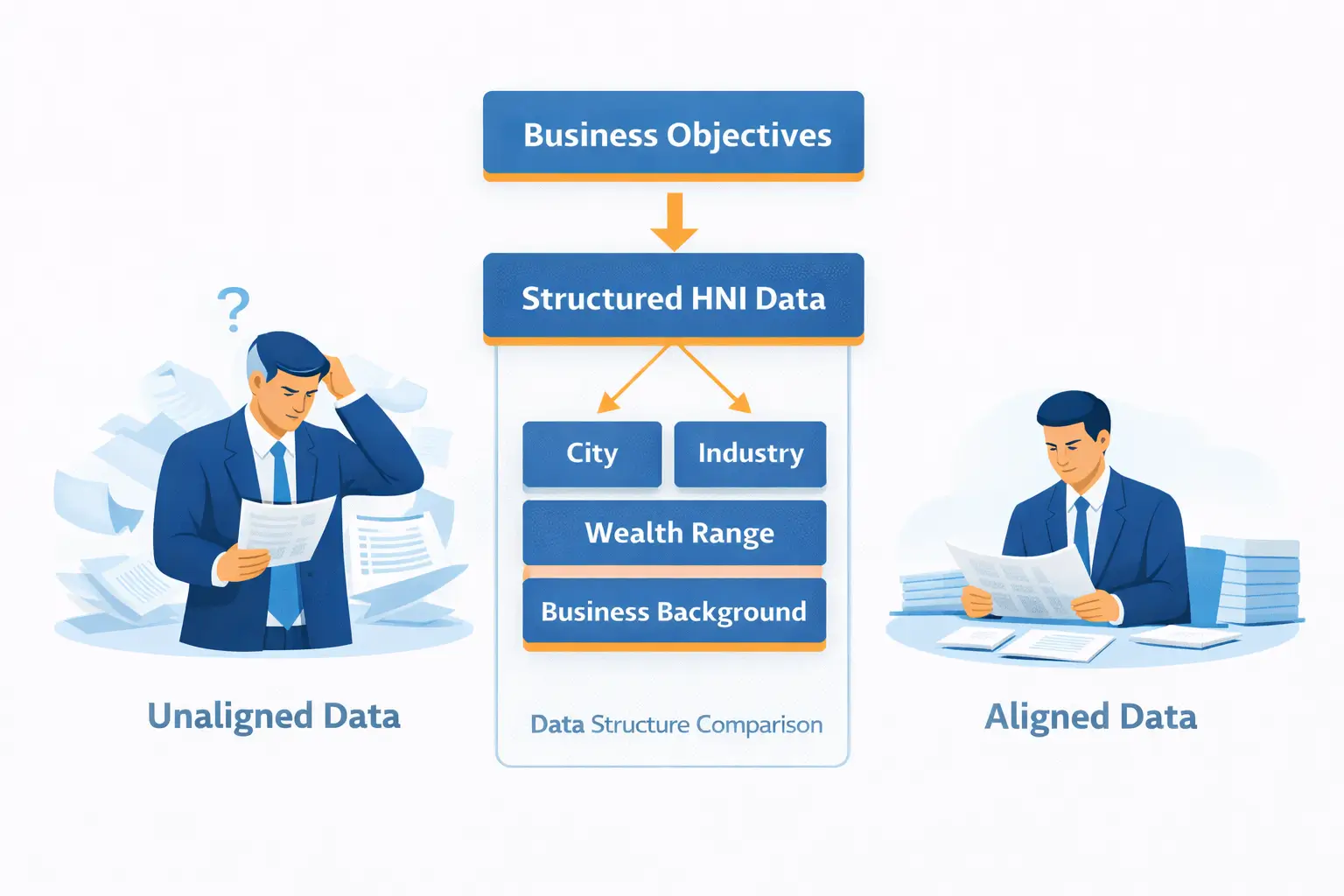
Aligning HNI Data With Business Objectives Before Usage

Aligning HNI data with business objectives is the most important step before using any HNI dataset.
Many businesses skip this step.
That mistake leads to confusion and poor outcomes.
HNI data is not magic.
It only works when aligning HNI data with business objectives is done clearly and early.
Why Aligning HNI Data With Business Objectives Matters
Without aligning HNI data with business objectives, data becomes noise.
Businesses often fail because they:
-
Buy data without a plan
-
Expect instant results
-
Ignore their real business goal
This failure pattern is explained clearly in
Why HNI Outreach Fails in India
What Aligning HNI Data With Business Objectives Really Means
Aligning HNI data with business objectives means matching data to purpose.
Before using HNI data, businesses must ask:
-
Why do we need this data?
-
What decision will it support?
-
Which segment actually matters?
Without these answers, data usage fails.
Defining Clear Business Objectives Before Using HNI Data
The first step in aligning HNI data with business objectives is clarity.
Common business objectives include:
-
Market research
-
City-wise expansion planning
-
Wealth behavior analysis
-
Strategic relationship mapping
Each objective needs different data.
How Wrong Objectives Break HNI Data Usage
Using HNI data without objectives creates problems.
When aligning HNI data with business objectives is skipped:
-
Segmentation becomes meaningless
-
Analysis becomes shallow
-
Expectations become unrealistic
This leads to wasted effort and frustration.
Role of Segmentation in Aligning HNI Data With Business Objectives
Segmentation is the bridge.
Aligning HNI data with business objectives depends on:
-
City segmentation
-
Industry segmentation
-
Wealth range segmentation
This structure is explained in
How HNI Data Is Segmented by City, Industry, and Wealth Range
City Alignment in Aligning HNI Data With Business Objectives
If your objective is regional growth, city data matters.
Aligning HNI data with business objectives requires:
-
Choosing the right cities
-
Avoiding irrelevant regions
-
Understanding local wealth behavior
City-level insight is explained in
City-Wise HNI Targeting in India
Industry Alignment in Aligning HNI Data With Business Objectives
Industry mismatch causes failure.
Aligning HNI data with business objectives means:
-
Matching industry background to your offering
-
Avoiding unrelated wealth segments
-
Understanding business-driven vs asset-driven wealth
Industry context improves planning accuracy.
Wealth Range Alignment in Aligning HNI Data With Business Objectives
Wealth range matters more than volume.
Aligning HNI data with business objectives requires:
-
Choosing HNI or UHNI correctly
-
Avoiding unrealistic targeting
-
Matching scale with capability
Wealth alignment prevents wrong expectations.
Why Data Quality Matters When Aligning HNI Data With Business Objectives
Even perfect objectives fail with poor data.
Aligning HNI data with business objectives only works when data is:
-
Verified
-
Clean
-
Structured
Data quality risks are explained in
Verified HNI Database – Data Quality & Compliance in India
What Aligning HNI Data With Business Objectives Does NOT Do
Important clarity.
Aligning HNI data with business objectives does NOT:
-
Guarantee outcomes
-
Predict buying behavior
-
Replace strategy or judgment
It supports better decisions, not shortcuts.
How Businesses Use Aligning HNI Data With Business Objectives Correctly
Smart businesses use aligning HNI data with business objectives to:
-
Plan before execution
-
Reduce risk
-
Improve decision quality
-
Save time and cost
Data works best when purpose is clear.
Simple Summary of Aligning HNI Data With Business Objectives
-
Objectives come before data
-
Alignment prevents misuse
-
Segmentation supports clarity
-
Data supports decisions, not promises
FAQs
Is aligning HNI data with business objectives mandatory?
Yes. Without it, data loses value.
Does alignment guarantee success?
No. It supports planning only.
Can objectives change later?
Yes. Data should be re-aligned if goals change.