
What Goes Wrong After Buying an HNI Database—and How to Avoid It

What goes wrong after buying an HNI database is often not the data itself.
It is how the data is understood and used.
Many businesses buy an HNI database with high expectations.
When results do not match those expectations, frustration begins.
Understanding what goes wrong after buying an HNI database helps avoid costly mistakes.
Why What Goes Wrong After Buying an HNI Database Is So Common
Most problems start before the data is even used.
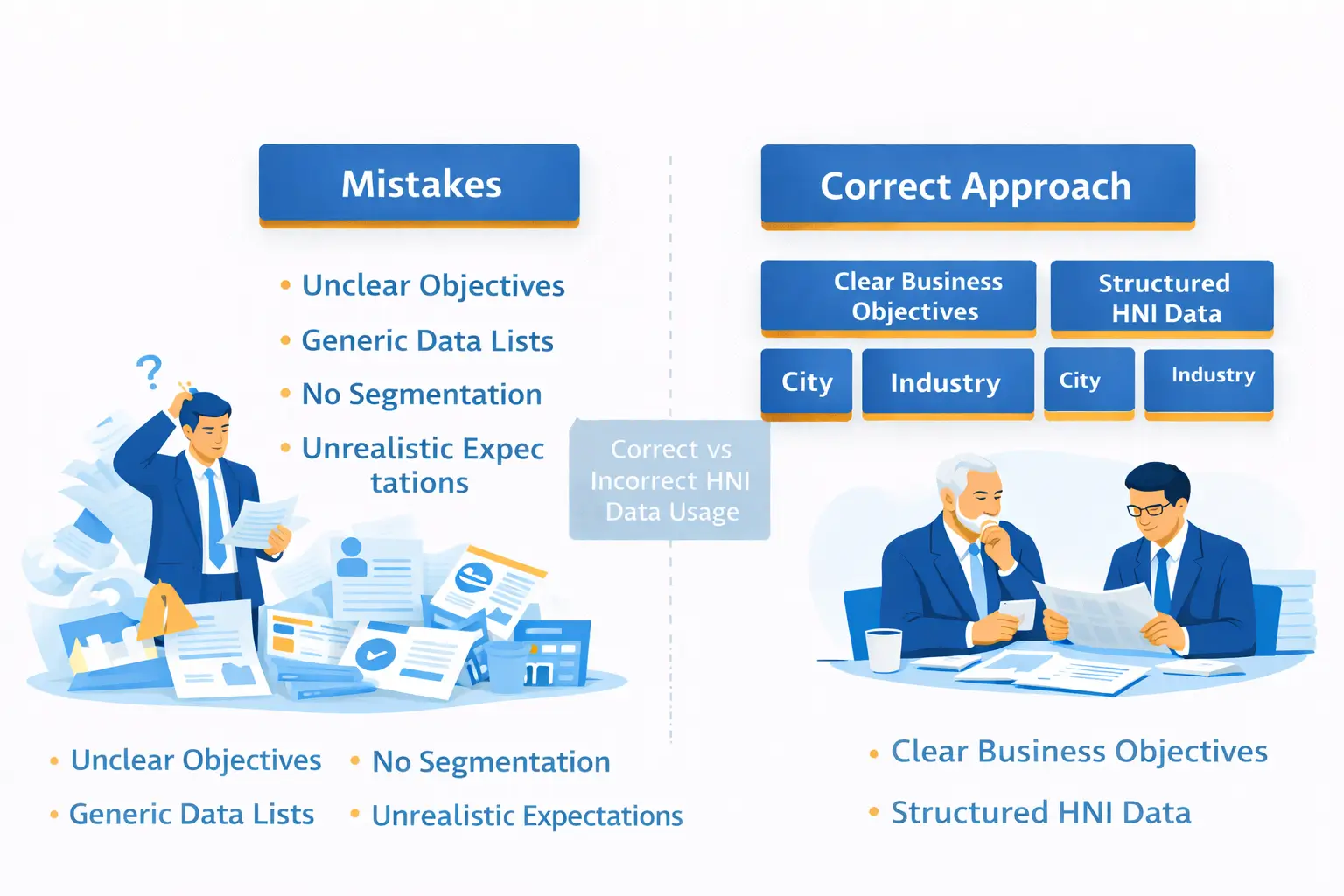
What goes wrong after buying an HNI database usually happens because:
-
Objectives are unclear
-
Data is misunderstood
-
Expectations are unrealistic
This pattern is explained clearly in
Why HNI Outreach Fails in India
Mistake 1: Expecting Ready-to-Convert Leads
The most common issue in what goes wrong after buying an HNI database is expectation mismatch.
An HNI database is:
-
Not a lead list
-
Not a guarantee of responses
-
Not a sales shortcut
It is a data foundation, not an outcome engine.
Mistake 2: No Alignment With Business Objectives
Another major reason what goes wrong after buying an HNI database is poor alignment.
Businesses often fail to ask:
-
Why do we need this data?
-
Which decision will it support?
Without alignment, data usage becomes random.
This concept is explained in
Aligning HNI Data With Business Objectives Before Usage
Mistake 3: Ignoring Segmentation Logic
Skipping segmentation creates confusion.
What goes wrong after buying an HNI database often involves:
-
Mixing cities
-
Mixing industries
-
Mixing wealth ranges
Without segmentation, analysis loses meaning.
Segmentation fundamentals are explained in
How HNI Data Is Segmented by City, Industry, and Wealth Range
Mistake 4: Treating All Cities the Same
City behavior differs widely.
A common reason what goes wrong after buying an HNI database is assuming:
-
Metro and Tier-2 cities behave the same
-
Wealth patterns are uniform
City-wise understanding is explained in
City-Wise HNI Targeting in India
Mistake 5: Overlooking Data Quality Limits
No dataset is perfect.
What goes wrong after buying an HNI database includes:
-
Expecting 100% accuracy
-
Ignoring verification limits
-
Misunderstanding update cycles
Data quality boundaries are explained in
Verified HNI Database – Data Quality & Compliance in India
Mistake 6: Using Generic Lists for Specific Needs
Generic data creates noise.
What goes wrong after buying an HNI database often involves:
-
Buying broad lists
-
Needing focused insights
Custom datasets perform better because they match intent.
This difference is explained in
Why Custom HNI Datasets Perform Better Than Generic Lists
How to Avoid What Goes Wrong After Buying an HNI Database
Avoiding failure requires discipline.
To avoid what goes wrong after buying an HNI database, businesses should:
-
Define objectives first
-
Choose relevant segments
-
Respect data limitations
-
Use data for planning, not promises
Data works best when purpose is clear.
What an HNI Database Is Actually Best Used For
An HNI database works well for:
-
Market research
-
City and industry analysis
-
Wealth behavior studies
-
Strategic planning
It is not designed for instant outcomes.
Simple Summary of What Goes Wrong After Buying an HNI Database
-
Expectations are often wrong
-
Objectives are unclear
-
Segmentation is ignored
-
Data limits are misunderstood
Avoiding these mistakes improves outcomes.
FAQs
Is buying an HNI database a mistake?
No. Using it incorrectly is the mistake.
Does an HNI database guarantee results?
No. It supports planning only.
Can mistakes be avoided?
Yes. With proper alignment and understanding.