
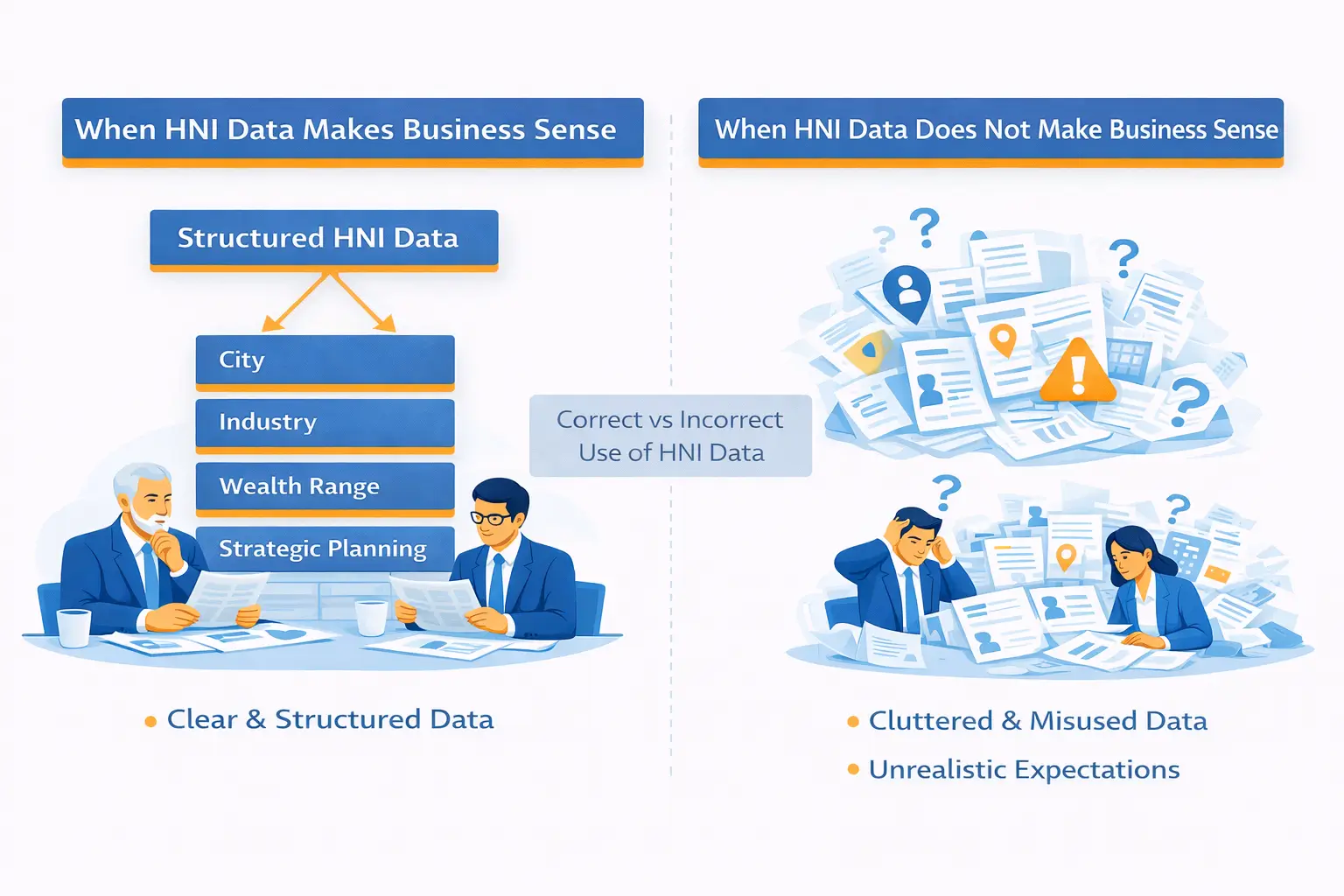
When HNI Data Makes Business Sense—and When It Does Not

When HNI data makes business sense, it helps businesses think clearly and plan better.
When it does not, it creates confusion, false hope, and wasted effort.
Many companies buy HNI data without asking one basic question.
Do we actually need this data?
Understanding when HNI data makes business sense is more important than buying the data itself.
Why Knowing When HNI Data Makes Business Sense Is Critical
HNI data is not meant for everyone.
When HNI data makes business sense, it supports:
-
Long-term thinking
-
Market understanding
-
Strategic planning
When used for shortcuts, it fails.
This confusion is explained clearly in
Why HNI Outreach Fails in India
When HNI Data Makes Business Sense for Indian Businesses
When HNI data makes business sense, businesses usually have:
-
High-value products or services
-
Long sales cycles
-
Relationship-based decision-making
-
A need for insight, not speed
In these situations, HNI data adds real value.
When HNI Data Makes Business Sense for Strategic Planning
Strategic planning is one of the strongest use cases.
When HNI data makes business sense in planning, companies use it to:
-
Study wealth distribution
-
Compare cities and regions
-
Understand industry concentration
This supports better decisions at the leadership level.
When HNI Data Makes Business Sense for Market Research
Market research requires clarity.
When HNI data makes business sense for research:
-
Businesses analyze where wealth exists
-
Patterns are studied, not chased
-
Decisions are made with context
Here, data is used to understand, not to sell.
When HNI Data Does NOT Make Business Sense
This part is often ignored.
When HNI data makes business sense does NOT include:
-
Expecting instant sales
-
Wanting mass leads
-
Running promotional campaigns
-
Short-term marketing goals
If speed and volume are the goal, HNI data is the wrong tool.
When HNI Data Does Not Make Business Sense for Execution
HNI data is not an execution system.
When HNI data makes business sense is before execution, not during it.
It does NOT:
-
Send messages
-
Generate responses
-
Guarantee conversions
Using it this way leads to disappointment.
Role of Objectives in When HNI Data Makes Business Sense
Objectives decide everything.
When HNI data makes business sense, businesses:
-
Define goals first
-
Choose relevant segments
-
Set realistic expectations
This alignment is explained in
Aligning HNI Data With Business Objectives Before Usage
Segmentation and When HNI Data Makes Business Sense
Segmentation gives meaning to data.
When HNI data makes business sense, it is:
-
Segmented by city
-
Filtered by industry
-
Classified by wealth range
Without segmentation, data loses value.
This structure is explained in
How HNI Databases Are Built and Used in India
Generic Lists vs Understanding When HNI Data Makes Business Sense
Generic lists blur purpose.
When HNI data makes business sense, custom datasets perform better because they match intent.
This difference is explained in
Why Custom HNI Datasets Perform Better Than Generic Lists
Simple Test to Know When HNI Data Makes Business Sense
Ask yourself three questions:
-
Is my offering high-value?
-
Is my decision long-term?
-
Do I need insight more than speed?
If yes, when HNI data makes business sense becomes clear.
What HNI Data Is Best Used For
HNI data works best for:
-
Strategic planning
-
Market mapping
-
City and industry analysis
-
Wealth behavior studies
It is not built for urgency or mass action.
Simple Summary of When HNI Data Makes Business Sense
-
HNI data supports thinking
-
It does not replace execution
-
Objectives define usefulness
-
Planning comes before action
FAQs
When HNI data makes business sense the most?
When used for planning and analysis.
Does HNI data guarantee results?
No. It supports decisions, not outcomes.
Can smaller businesses use HNI data?
Yes, if expectations are realistic.