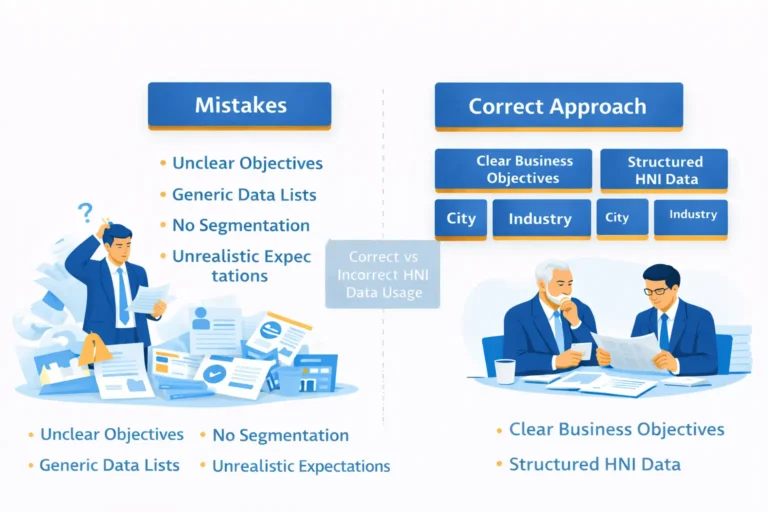

Understanding Coverage Gaps in Indian HNI Databases

Understanding Coverage Gaps in Indian HNI Databases
HNI database coverage gaps confuse many Indian businesses.
Most buyers expect full market visibility.
However, no database covers everything.
That is the reality.
When businesses ignore HNI database coverage gaps, planning suffers.
Therefore, understanding gaps becomes essential.
Why HNI Database Coverage Gaps Exist in India
India is complex.
Wealth is not evenly visible.
As a result, HNI database coverage gaps appear naturally.
Several reasons cause this:
-
Private ownership structures
-
Limited public disclosures
-
Regional data variation
This challenge is explained clearly in
Why No HNI Database in India Is 100% Accurate
How Geography Creates HNI Database Coverage Gaps
Cities show wealth differently.
Some regions report more data.
Therefore, HNI database coverage gaps grow across locations.
Metro cities show higher visibility.
However, smaller cities stay underreported.
This regional difference is explained in
City-Wise HNI Targeting in India
Industry Patterns Behind HNI Database Coverage Gaps
Not all industries publish information.
Some sectors stay private.
As a result, HNI database coverage gaps widen by industry.
For example:
-
Family businesses disclose less
-
Asset-heavy sectors stay quiet
This pattern is explained in
How HNI Databases Are Built and Used in India
Why Verification Does Not Remove Coverage Gaps
Many buyers misunderstand verification.
Verification checks structure, not completeness.
Therefore, HNI database coverage gaps still exist.
Verified does not mean full.
Verified means carefully curated.
This misunderstanding is explained in
What “Verified” Really Means in Indian HNI Databases
How Large Databases Hide HNI Database Coverage Gaps
Large databases look impressive.
However, size hides missing segments.
As a result, HNI database coverage gaps stay unnoticed.
Smaller structured datasets reveal gaps faster.
They improve clarity.
This difference is explained in
Why Custom HNI Datasets Perform Better Than Generic Lists
Impact of HNI Database Coverage Gaps on Business Decisions
Ignoring gaps creates false confidence.
False confidence leads to wrong decisions.
Therefore, HNI database coverage gaps affect:
-
Market size estimates
-
Expansion planning
-
Risk evaluation
This mistake is discussed in
What Goes Wrong After Buying an HNI Database—and How to Avoid It
How Businesses Should Respond to HNI Database Coverage Gaps
Smart businesses plan around gaps.
They do not deny them.
To manage HNI database coverage gaps, businesses should:
-
Use data for insight
-
Avoid absolute assumptions
-
Combine multiple views
This approach is explained in
Aligning HNI Data With Business Objectives Before Usage
Why HNI Database Coverage Gaps Do Not Mean Failure
Gaps are normal.
They do not make data useless.
HNI database coverage gaps signal limits.
Limits guide better decisions.
Understanding limits improves strategy.
Ignoring limits creates risk.
Simple Summary
-
No database covers all HNIs
-
Gaps exist by city and industry
-
Verification does not remove gaps
-
Awareness improves decisions
That is why HNI database coverage gaps must be understood early.
FAQs
Are coverage gaps avoidable?
No. They are natural.
Do larger databases reduce gaps?
Not always. Structure matters more.
How should businesses treat gaps?
As planning boundaries.