How to Identify an Unreliable HNI Data Provider in India

Introduction: Why This Matters More Than You Think
unreliable HNI data provider India
Many businesses in India lose money before they even use HNI data.
The reason is simple:
👉 They choose the wrong HNI data provider.
An unreliable provider does not just give poor data.
They create:
-
Legal risk
-
Reputation damage
-
False expectations
-
Internal confusion
This blog explains how to identify an unreliable HNI data provider in India, using simple signs that anyone can understand.
Red Flag #1: They Promise 100% Accuracy
unreliable HNI data provider India
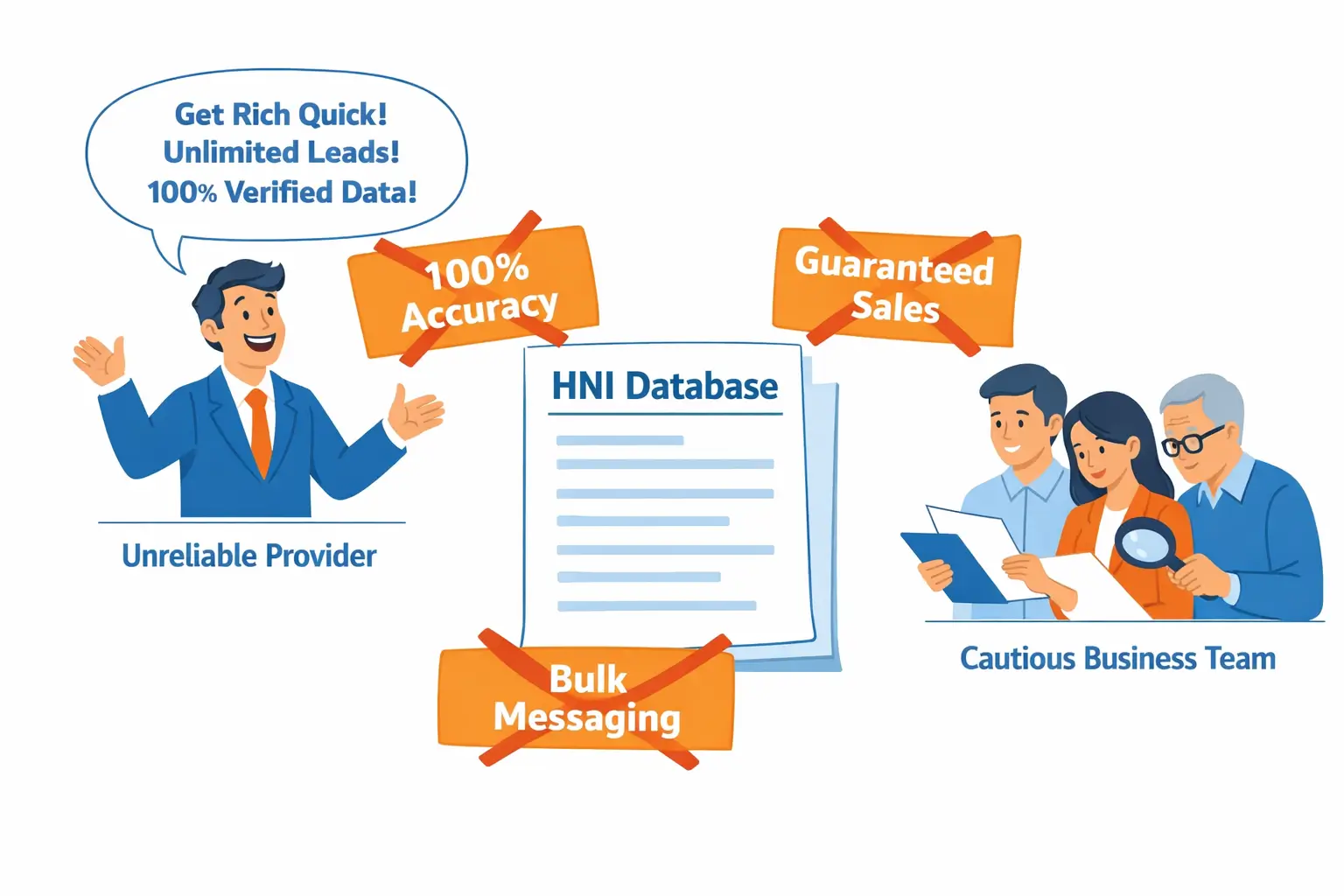
This is the biggest warning sign.
No HNI database in India can be 100% accurate.
If a provider promises:
-
“100% verified data”
-
“All contacts guaranteed”
-
“Every number works”
They are not being honest.
This unrealistic promise is one of the main reasons explained in
why no HNI database is 100% accurate
Red Flag #2: They Guarantee Sales or Responses
unreliable HNI data provider India
HNI data is not a sales tool.
Any provider saying:
-
“You will get clients”
-
“Responses are guaranteed”
-
“Conversions are assured”
is misleading you.
Data supports understanding, not outcomes.
This misunderstanding causes the failures explained in
why HNI outreach fails
Red Flag #3: They Encourage Mass Marketing
unreliable HNI data provider India
Unreliable providers often say:
-
“Send bulk WhatsApp”
-
“Do mass calling”
-
“Blast emails to all”
This is dangerous.
HNIs do not respond well to mass marketing.
It creates complaints, blocks, and trust issues.
This misuse is exactly why
HNI databases do not work for mass marketing
Red Flag #4: No Clear Explanation of Data Source
A reliable provider can explain:
-
Where data comes from
-
How it is curated
-
How often it is updated
An unreliable provider avoids these questions.
If answers are vague, unclear, or secretive, walk away.
Good practices are explained clearly in
how HNI databases are built and used
Red Flag #5: No Talk About Compliance or Privacy
If a provider never mentions:
-
Compliance
-
Responsible usage
-
Privacy boundaries
That is a serious risk.
Reliable providers always explain how data should be used safely.
This is why understanding
data quality and compliance checks
is critical before buying.
Red Flag #6: They Sell “One-Size-Fits-All” Data
India is not one market.
HNIs behave differently by:
-
City
-
Industry
-
Wealth source
Unreliable providers sell generic lists without context.
Smart businesses look at insights like
wealth patterns in Mumbai
to understand how location affects data quality.
Red Flag #7: Very Cheap Pricing for “Premium” Data
HNI data requires:
-
Research
-
Verification
-
Manual effort
If pricing sounds too cheap, something is missing:
-
Data freshness
-
Accuracy
-
Compliance
-
Context
Cheap data often becomes expensive later.
Red Flag #8: No Education, Only Selling
Reliable providers educate first.
Unreliable providers:
-
Push urgency
-
Avoid explaining limits
-
Focus only on closing the deal
If a provider never explains what the data cannot do, that is a warning sign.
This behaviour leads directly to the problems discussed in
what businesses get wrong before buying an HNI database
How Smart Businesses Choose the Right Provider
Smart businesses look for providers who:
-
Set realistic expectations
-
Talk openly about limitations
-
Explain responsible usage
-
Focus on understanding, not hype
Industries like real estate follow this approach carefully, as shown in
real estate decision planning
Simple Checklist Before You Buy
Before choosing a provider, ask:
-
Do they promise realism or miracles?
-
Do they explain compliance clearly?
-
Do they discourage mass marketing?
-
Do they educate before selling?
If answers feel uncomfortable, do not proceed.
Key Takeaways
-
No honest provider promises 100% accuracy
-
HNI data never guarantees sales
-
Mass marketing advice is a red flag
-
Compliance talk is a must
-
Education matters more than hype
FAQs
How can I verify an HNI data provider?
Ask about accuracy limits, compliance, and usage guidance.
Is cheap HNI data reliable?
Usually no. Quality data requires effort and cost.
What is the biggest red flag?
Guaranteed results or 100% accuracy claims.