
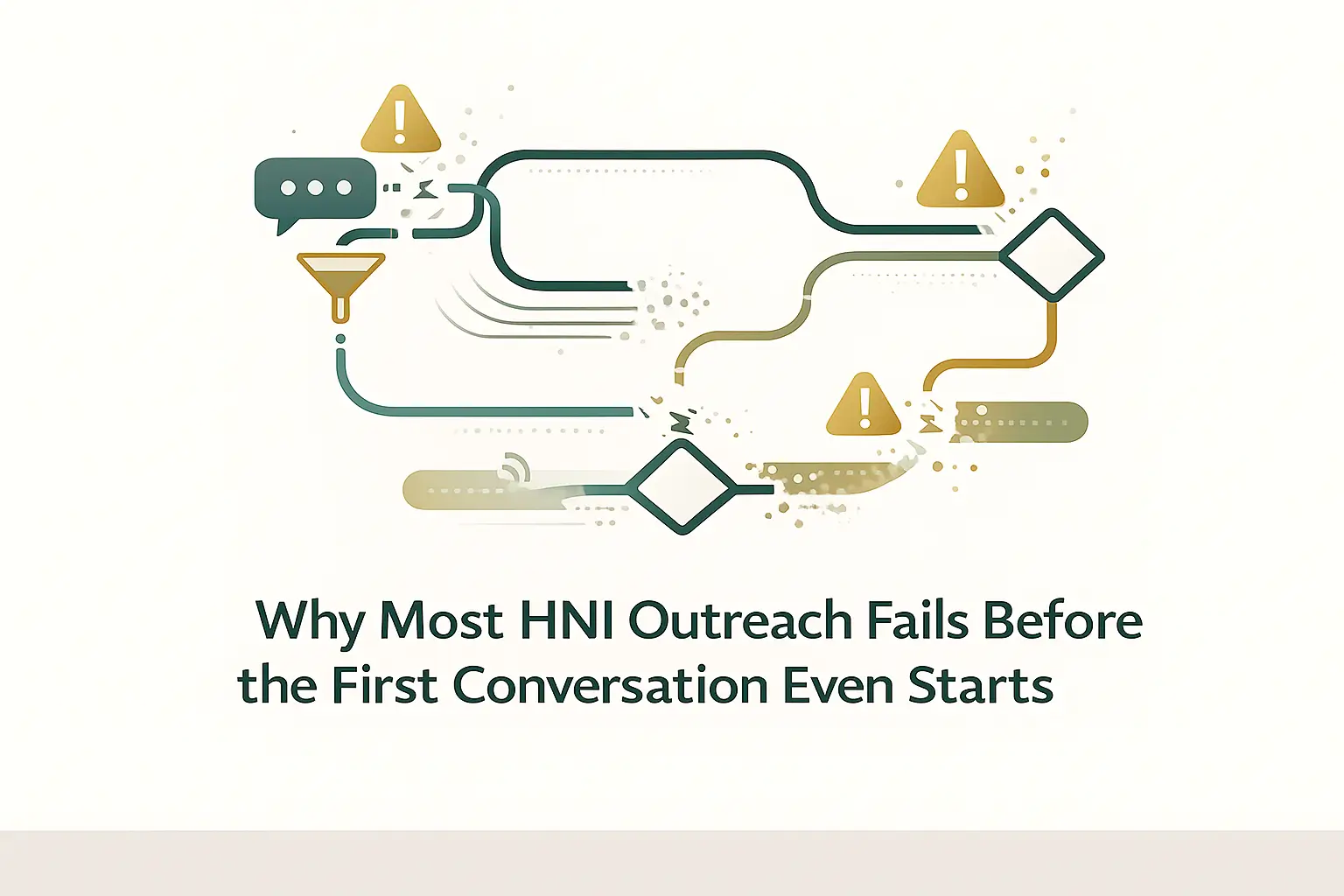
Why Most HNI Outreach Fails Before the First Conversation Even Starts

Introduction: The Failure Nobody Measures
When HNI-focused campaigns fail, most businesses look in the wrong place for answers. They examine response rates, call durations, meeting conversions, or closure timelines. By the time those metrics appear, the real failure has already occurred.
The truth is uncomfortable but simple:
Most HNI outreach in India collapses before the first real conversation ever begins.
Not because the offer is weak.
Not because the brand lacks credibility.
And not because the audience is wrong.
It fails because the outreach never aligns with the moment of decision openness. This blog explores why that happens, what most teams misunderstand about premium outreach, and how market intelligence—not louder communication—determines outcomes.
The Hidden Stage No One Plans For: Pre-Conversation Collapse
Every outreach effort has an invisible stage that rarely gets discussed: pre-conversation filtering.
This is the phase where:
-
Messages are seen but not processed
-
Emails are read but mentally postponed
-
Introductions are acknowledged but not acted upon
From the outside, it looks like silence. Internally, a decision has already been made: “Not relevant right now.”
Once this classification happens, follow-ups rarely recover the opportunity.
Decision Readiness Is Not a Personality Trait
A common mistake in premium outreach is assuming that responsiveness is a personality characteristic. It is not.
HNIs move through decision readiness cycles. These cycles are shaped by:
-
Capital allocation timing
-
Market uncertainty or confidence
-
Business expansion or contraction
-
Asset rebalancing phases
An HNI who ignores outreach today may engage deeply six months later—not because the message changed, but because their internal context did.
Most outreach strategies fail because they treat readiness as static instead of cyclical.
Why “Good Messaging” Still Fails
Many teams believe that refining messaging will solve engagement problems. They invest heavily in:
-
Better copy
-
Polished decks
-
Improved pitch structures
Yet results remain inconsistent.
This happens because messaging quality cannot compensate for context mismatch.
When outreach arrives outside a decision window, even excellent messaging feels irrelevant. The recipient does not reject it consciously—it simply never enters the decision pipeline.
The Noise Accumulation Effect
HNIs are not overwhelmed by individual messages. They are affected by accumulated noise.
Each irrelevant outreach adds to a silent internal filter:
-
The first few messages are ignored neutrally
-
Later messages are ignored reflexively
-
Eventually, the sender is categorized as background noise
Once this happens, future outreach—even when relevant—faces resistance.
This is why premature or poorly timed campaigns damage long-term engagement potential without showing immediate negative signals.
Why Scale Creates Blindness in Premium Outreach
Large outreach campaigns create a dangerous illusion of control. Dashboards show:
-
High delivery rates
-
Stable system performance
-
Predictable activity
What they do not show is decision misalignment.
Scale-driven outreach removes discretion. It prioritizes coverage over timing and assumes that repeated exposure will eventually trigger engagement.
In premium segments, the opposite is true. Repetition outside readiness windows reduces perceived value.
This is why organizations that rely on structured, intelligence-driven datasets consistently outperform those chasing volume.
Timing Signals Exist—But Are Often Ignored
Decision readiness is not random. It leaves traces.
Signals include:
-
Market expansion phases
-
Investment cycle shifts
-
Sector-specific momentum
-
Geographic demand surges
Most outreach teams ignore these signals because they operate independently of market intelligence.
Without timing signals, outreach becomes guesswork. With timing signals, it becomes strategic.
Why Geography Influences Decision Timing
Decision readiness is not uniform across regions.
Local factors influence when HNIs become receptive:
-
Property market cycles
-
Business climate shifts
-
Sector concentration
-
Peer investment behavior
This is why city-level intelligence improves outreach outcomes—not because of personalization, but because of temporal accuracy.
For example, engagement patterns in Mumbai’s investment ecosystem differ meaningfully from those in Delhi’s professional landscape.
City-wise insights help outreach land closer to readiness windows, not just closer to inboxes.
Silence Is a Signal, Not a Failure
Most teams treat silence as rejection and react aggressively:
-
More follow-ups
-
Shorter intervals
-
Increased urgency
This is a mistake.
In premium outreach, silence usually means contextual misalignment, not disinterest. Escalation worsens the mismatch.
High-performing teams interpret silence diagnostically. They pause, reassess timing, and re-enter only when context changes.
The Cost of Early Misalignment
Misaligned outreach carries long-term costs that are rarely measured:
1. Cognitive Exclusion
Once categorized as irrelevant, future messages face subconscious resistance.
2. Trust Erosion
Persistent premature outreach reduces perceived selectivity.
3. Opportunity Suppression
Even strong future offers face delayed engagement.
These costs compound quietly across campaigns.
Why Market Intelligence Reduces Early Failure
Market intelligence does not aim to increase outreach frequency. It aims to reduce unnecessary contact.
It helps teams:
-
Prioritize readiness over reach
-
Sequence outreach intelligently
-
Respect decision cycles
This leads to fewer messages but stronger conversations.
Organizations that integrate intelligence into outreach strategy stop asking “Why didn’t they respond?” and start asking “Was this the right moment?”
Structured Data as a Timing Filter
Structured datasets enable outreach filtering beyond demographics.
They support:
-
Relevance-based sequencing
-
Controlled pilot outreach
-
Reduced premature exposure
This is fundamentally different from static lists.
Many organizations prefer to review sample datasets to assess whether timing and segmentation depth align with their strategy before scaling.
A Better Mental Model for Premium Outreach
Replace this question:
“How do we increase responses?”
With this one:
“How do we avoid contacting people too early?”
This shift alone eliminates a large percentage of outreach failure.
Final Perspective: Conversations Begin Before Messages Are Sent
The success of HNI outreach is decided long before the first message is delivered.
It is decided at the intersection of:
-
Timing
-
Context
-
Readiness
When outreach aligns with these factors, conversations feel natural. When it does not, silence follows.
Understanding this difference separates noise-driven campaigns from intelligence-driven engagement.
Authority Closing Line
HNIDatabaseProvider.com helps businesses align HNI outreach with market intelligence, timing awareness, and structured decision signals.